

What Are the Main Types of Casino Games?
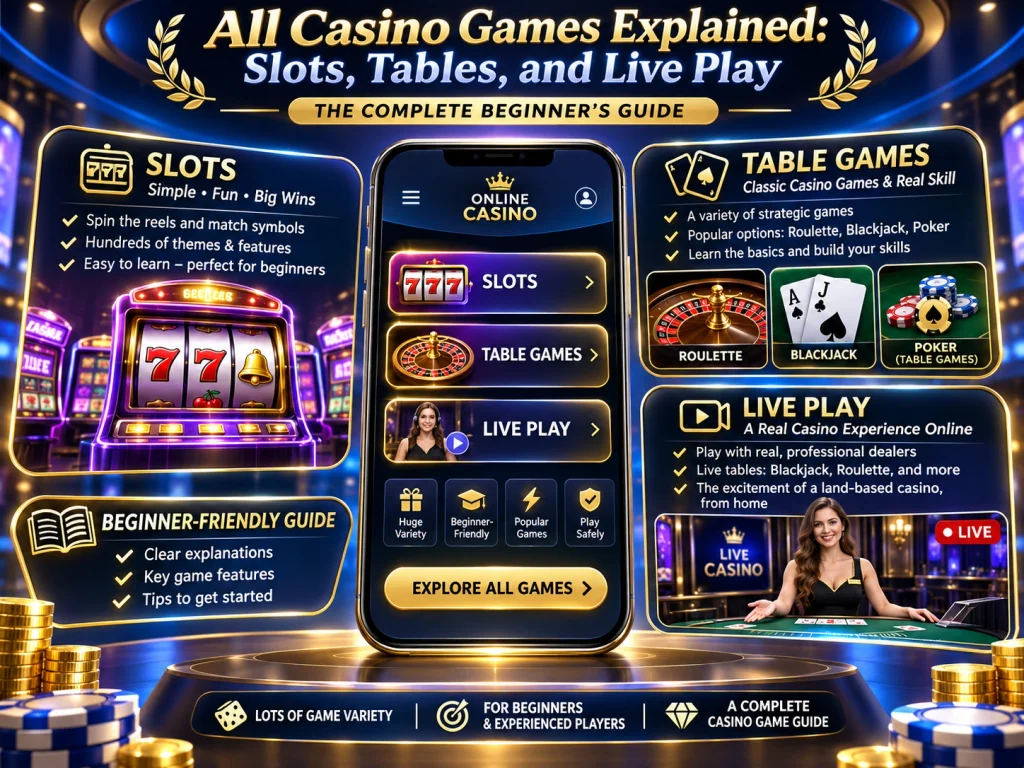
All Casino Games the most useful starting point is to separate the game’s rules from the way it is presented. Roulette describes a game; live dealer describes a format. A live roulette table belongs to both categories.
| Category | Common examples | What you do | What to check first |
| Slots and other RNG games | Reel slots, electronic card games, electronic roulette | Set a stake and start a spin or round; some games include further decisions | Winning conditions, controls, and payout information |
| Table games | Blackjack, baccarat, roulette, casino poker variants | Place bets and, where required, make decisions during the round | The exact version and its rules |
| Live dealer games | Live blackjack, baccarat, and roulette | Place bets through an interface while a dealer hosts the game | Table limits, betting deadlines, and game rules |

Slots and Other RNG Games
RNG stands for random number generator. In electronic casino games, this software mechanism determines outcomes according to the game’s design.
Reel slots are a familiar example: you choose a stake, start a spin, and the game checks the result against its payout rules. Electronic versions of card and wheel games also use RNG systems, although their interfaces look different.
The screen’s appearance does not tell you everything about the mechanics. Two slots with similar artwork can use different winning patterns, bonus triggers, and betting controls. Reading the rules is more useful than judging a game by its theme.
Table Games: Blackjack, Baccarat, Roulette, and Poker
Table games differ mainly in what you bet on and how much you decide after a round begins.
In blackjack, you make decisions about your hand, such as taking another card or standing. In baccarat, you generally choose a betting outcome before the cards are dealt, while drawing rules govern what happens next. In roulette, you place bets on numbers or groups of numbers before the result.
Poker needs an extra distinction. Some versions involve competing against other players; casino poker variants can involve playing against the dealer under a separate set of rules. A game labeled “poker” therefore needs a closer look before you assume how it works.
Live Dealer Games
Live casino games combine a dealer video feed with digital betting controls. You watch the dealer host the game, but use the interface to select and submit your bets.
This changes the experience and timing. A live table has betting windows, so you must finish placing a bet before the deadline. You also follow the table’s round rather than starting every round whenever you choose.
A live format does not, by itself, tell you the odds or payout rules. Those still depend on the underlying game and the table’s specific version.
How Do Slot Games Work?
A slot checks the symbols produced by a spin against its winning rules. Your first task is to identify where a winning combination must appear, which symbols qualify, and what stake the displayed payouts refer to.
Reels, Paylines, and Ways to Win
Reels are the columns of symbols shown on the screen. Paylines are defined paths across those reels that the game uses to check for wins.
For a hypothetical example, a slot might require three matching symbols on consecutive reels, beginning with the leftmost reel, along an active payline. Three matching symbols scattered elsewhere on the screen would not meet that particular rule.
“Ways to win” games can check matching symbols across adjacent reels without requiring them to follow a fixed payline. Other slots use clusters of touching symbols. These systems are different, so “matching symbols” alone is not a complete explanation of how a slot pays.
Before spinning, look for a rule that answers this question: Where must the symbols land for the combination to count?
Wilds, Scatters, and Bonus Features
Wilds commonly substitute for certain symbols to help complete a winning combination. That substitution can have exceptions; a wild might not replace a scatter or another special symbol.
Scatters often have separate rules. They may award a payout, trigger a feature, or count without landing on a payline. The required number and eligible positions depend on the game.
Bonus features can include free spins, multipliers, or additional rounds. A feature’s name does not explain its full behavior. For example, a multiplier might apply to one combination, one spin, or a feature total. Check which amount it multiplies before interpreting a displayed result.
What to Check in the Paytable Before Playing
I would read a slot’s paytable in this order:
- Confirm the total stake. Check the amount charged for a complete spin, including any selected options.
- Find the winning pattern. Establish whether the game uses paylines, ways, clusters, or another system.
- Read the symbol values. Check how many matching symbols are required and how payouts are expressed.
- Check special-symbol exceptions. Read what wilds can replace and how scatters count.
- Read the bonus trigger and feature rules. Identify what activates the feature and whether any optional feature changes the cost.
The payout unit deserves particular attention. In a hypothetical game, a payout shown as 10× the total stake would equal 10 units on a 1-unit spin. A display of 10 credits means something different unless you also know the credit value. Reading that label prevents a basic—and potentially expensive—misunderstanding.
Once you can explain the stake, winning pattern, and special symbols in your own words, you have a useful foundation for understanding that slot’s rules.
How Do the Main Table Games Compare?
The biggest difference between table games is when you make decisions and what those decisions affect. Blackjack includes choices after cards are dealt. Baccarat and roulette generally ask you to select your bets before the result. Poker depends on the version you choose.
| Game | Main player action | Key rule to understand | Version detail to check |
| Blackjack | Take cards, stand, or use other permitted actions | How your hand is compared with the dealer’s | Dealer rules, available actions, and blackjack payout |
| Baccarat | Bet on Player, Banker, or Tie | Drawing rules determine how the hands are completed | Commission and payout conditions |
| Roulette | Bet on numbers or groups of numbers | Where each bet applies on the wheel | Number of zero pockets and payout table |
| Poker | Make decisions under the variant’s rules | Who you compete against and how hands are ranked | Player-versus-player or casino table format |
Blackjack: Decisions During the Hand
Blackjack asks you to build a hand closer to 21 than the dealer’s without going over. Number cards use their face values, face cards count as 10, and an ace can count as 1 or 11.
Your decisions matter because the hand does not necessarily end with the first two cards. Hit means taking another card; stand means keeping your current total. Some situations permit actions such as doubling down or splitting a pair, subject to the table rules.
Consider a hand containing a 10 and a 6. Its total is 16, but that number alone is not enough to explain the decision: the dealer’s visible card and the applicable rules also matter. That is why a useful blackjack guide considers the full situation rather than offering a rule such as “always take another card below 17.”
Before joining a table, check how the dealer plays a soft 17—a hand totaling 17 with an ace counted as 11—and what the table pays for a blackjack. Those details help distinguish versions that otherwise look almost identical.

Baccarat: Choosing a Betting Outcome
In baccarat, Player and Banker name two hands. You can bet on either one; choosing Banker does not mean becoming the dealer or managing the game.
The main bets are on the Player hand winning, the Banker hand winning, or the round ending in a Tie. Once bets close, drawing rules determine whether either hand receives another card. You do not choose whether to hit or stand as you would in blackjack.
Hand totals use the last digit of the cards’ combined value. For example, a 7 and an 8 produce a baccarat total of 5. Tens and face cards count as zero, while aces count as one.
Read the payout conditions before selecting a bet. Some versions apply commission to winning Banker bets; others use different payment conditions. Side bets have their own rules and should be checked separately from the main outcome bets.
Roulette: Number Bets and Group Bets
Roulette lets you bet on an individual number or a group of numbers. A straight-up bet covers one number; other bets cover combinations such as red, black, odd, even, or a dozen.
Covering more numbers changes both how often a bet can win and what it pays. It does not remove losing outcomes.
Take a red bet as an example. On a standard single-zero wheel, 18 pockets are red, 18 are black, and one is zero. Zero is neither red nor black, so a red bet does not cover half of all 37 pockets.
Check the wheel layout before betting. A double-zero wheel includes an additional pocket, which changes the probabilities. The familiar red-and-black betting grid can look similar even when the wheel differs.
Poker: Check Which Version You Are Playing
“Poker” does not identify one universal casino game. In player-versus-player poker, you compete with other participants under the chosen variant’s betting and hand-ranking rules. In casino table variants, you may instead compare your hand with the dealer’s.
That distinction changes what you need to learn. A player-versus-player game can involve betting rounds, folding, and decisions based on other players’ actions. A casino poker variant may use an opening wager followed by a defined decision to continue or fold.
Before playing, answer three questions: Who am I competing against? Which hand rankings apply? What additional wager might be required after the opening bet? Those answers are more useful than relying on the word “poker” in the game title.
How Is Live Casino Play Different from Electronic Games?
Live casino play combines a dealer-hosted game with an on-screen betting interface. The practical difference is timing: you follow the table’s rounds and submit decisions within its deadlines.
Dealer Video, Betting Interfaces, and Result Displays
The video shows the dealer hosting the game. The interface handles actions such as selecting a chip value, placing a bet, or making a permitted decision.
Treat these as separate parts of the experience. Watching the dealer does not confirm that your bet was accepted. Check the interface’s accepted-bet indicator or equivalent confirmation before assuming you have entered the round.
After the result, review the displayed settlement. If something appears unclear, the available round history and game information can help you identify which bet was recorded and how it was resolved.
Betting Windows and Round Timing
Live tables close betting before completing a round. A countdown usually indicates how much time remains, but you still need enough time to choose the correct stake and confirm your action.
For a hypothetical example, suppose you intend to place one 1-unit chip but click the betting area twice. You may have submitted a 2-unit bet. Checking the total before betting closes is more reliable than judging the number of chips shown in an animation.
Decision-based games can also impose action deadlines. Read the table’s instructions for what happens if you do not respond in time; do not assume every game uses the same default action.
What to Check Before Joining a Live Table
Use a short check before entering a round:
- Table limits: Confirm that the minimum bet fits your planned spending limit.
- Exact rules: Read the payout conditions and any rules specific to that table.
- Connection and controls: Make sure the stream and interface respond consistently.
- Bet confirmation: Find where accepted bets and the total stake appear.
- Timing: Observe a round to understand when betting opens, closes, and settles.
A live dealer changes how the game is hosted. The underlying rules and payouts still determine how a bet works, so the video feed should never replace reading the table information.
How Can Beginners Compare All Casino Games?
Compare games by their rules, total stake, and pace. A familiar theme or a low minimum bet tells you little about how much attention a game requires—or how quickly repeated bets can add up.
Start with Rules You Can Explain in Your Own Words
Before placing a bet, try answering four questions:
- What result am I betting on?
- What is the total cost of entering this round?
- Do I need to make another decision after the round starts?
- What conditions determine the payout?
If any answer is unclear, return to the rules screen.
For example, understanding that roulette involves a spinning wheel is not enough. You should also know which pockets your selected bet covers. Similarly, recognizing blackjack’s goal of reaching a total close to 21 does not explain when splitting or doubling requires an additional wager.
My starting point would be the total stake: identify what leaves the balance when the round begins, then check whether later actions can increase that amount.
Compare Minimum Bets and Playing Pace Together
A lower minimum bet does not automatically mean a lower session cost. The number of rounds matters too.
Consider two hypothetical sessions:
| Example | Stake per round | Rounds played | Total amount wagered |
| Session A | 1 unit | 60 | 60 units |
| Session B | 2 units | 20 | 40 units |
Session A uses the smaller stake but produces more total wagering because it includes more rounds.
Total amount wagered is not the same as net loss. It adds up every stake, including money wagered again after a payout. The example illustrates betting volume, not a prediction of either session’s result.
When comparing games, consider how often you expect to place a bet and whether features such as autoplay or repeat betting could make spending harder to track.
Use Demo Play Where It Is Available
A demo mode can help you locate controls, read the payout display, and understand how a round progresses without staking money.
Use it to complete specific tasks: change the stake, find the rules, identify a winning combination, and check how the game displays the result. This makes the practice useful even if no bonus feature appears.
Demo results do not establish what will happen in a later cash session. A few winning rounds are a small sample, and virtual credits do not reproduce the pressure of spending money. Treat demo play as an interface lesson.
What Should You Check Before Playing Any Casino Game?
Check the exact version, how payouts are expressed, and your spending limit. These checks address three different questions: Which rules apply? What does the displayed return mean? How much am I prepared to spend?
Confirm the Exact Game Version and Rules
Games with the same name can have different rules. Before starting, open the information panel rather than relying on what you remember from another table.
Useful checks include:
| Game | Detail to confirm |
| Blackjack | Blackjack payout, dealer drawing rules, and restrictions on splitting or doubling |
| Baccarat | Banker commission or alternative payout conditions |
| Roulette | Single-zero, double-zero, or another wheel layout |
| Casino poker | Opening wager, continuation wager, and dealer qualification rules |
| Slots | Winning pattern, payout units, and the cost of optional features |
If an optional feature changes the stake, calculate the full cost before activating it. A prominently displayed base bet may not explain every paid option on the screen.
Read Payout Information in Context
A payout multiplier, winning frequency, and return to player describe different things.
A multiplier tells you how a qualifying result is paid under the stated rules. Winning frequency describes how often winning results occur, but a winning result can pay less than the stake used to obtain it. RTP describes a theoretical long-run return across a large volume of play; it does not forecast an individual session.
For a hypothetical example, a game with a stated 96% RTP does not promise to return 96 units from your next 100 units wagered. Short-term outcomes can differ substantially.
Also check whether a displayed return includes the original stake. If a 1-unit bet produces a total return of 2 units, the net profit is 1 unit. Reading the label prevents you from confusing the amount returned with the amount gained.
Set a Spending Limit and a Stopping Point
Choose an amount you can afford to lose before opening a game. Keep it separate from money needed for bills, savings, or other commitments.
A practical plan defines:
- A spending limit: The maximum amount available for the session.
- A stake: An amount that fits that limit, including possible additional wagers.
- A time limit: A clear point to finish playing.
- A stopping rule: End the session when the money or time limit is reached.
These limits control spending and time; they do not improve the odds. If the planned amount is gone, increasing the next stake to recover it creates further exposure without changing the previous result.
Which Casino Game Category Should You Explore First?
Start with a category whose rules you can follow and whose pace gives you time to check your actions. The right starting point depends on the experience you want, not a promise of easier winnings.
If You Prefer Fewer On-Screen Decisions
You might first study a straightforward slot or the main bets in baccarat. These can involve fewer decisions during a round than blackjack or some poker variants.
Fewer decisions do not necessarily mean simpler payout rules. A slot with several bonus systems may require more reading than its spin button suggests. Start by finding the basic winning conditions, then examine optional features separately.
If You Want Decisions During Each Round
Blackjack and some poker formats offer decisions after the initial deal. Explore these if you want to learn how available actions change with the situation.
Begin with one version. In blackjack, learn card values and the permitted actions before examining more detailed strategy. In poker, establish whether you are competing against other players or the dealer before studying betting decisions.
Making more decisions gives you more to learn. It does not guarantee a profitable result.
If You Prefer a Dealer-Led Format
A live table may suit you if you prefer watching a dealer host each round and can comfortably follow betting deadlines.
Observe a round before joining. Locate the stake controls, accepted-bet display, countdown, and results area. If you feel rushed finding those controls, spend more time learning the interface before committing money.
Where to Go Next with PT Gaming
Understanding all casino games starts with a few useful distinctions: the rules, the format, the decisions required, and the total stake. Once those are clear, individual game guides become easier to follow.
For your next step, visit PT Gaming Insights and look for content about the category you want to understand better. Focus on one game’s rules at a time, and confirm the exact version before playing.
FAQ
What Are the Main Types of Casino Games?
The main categories include slots, table games, and live dealer games. These categories overlap: blackjack, baccarat, and roulette are table games that can appear in electronic or live dealer formats.
Are Live Casino Games Different from Table Games?
“Live” describes how a game is hosted, while “table game” describes the underlying game. Live roulette, for example, uses a dealer-hosted video feed alongside digital betting controls. Check the specific table rules and betting deadlines before joining.
What Is the Difference Between Slots and Table Games?
Slots typically involve starting a spin and checking symbol combinations against a paytable. Table games use card, wheel, or other defined rules. Some, such as blackjack, require decisions during a round; others generally require selecting bets before the result.