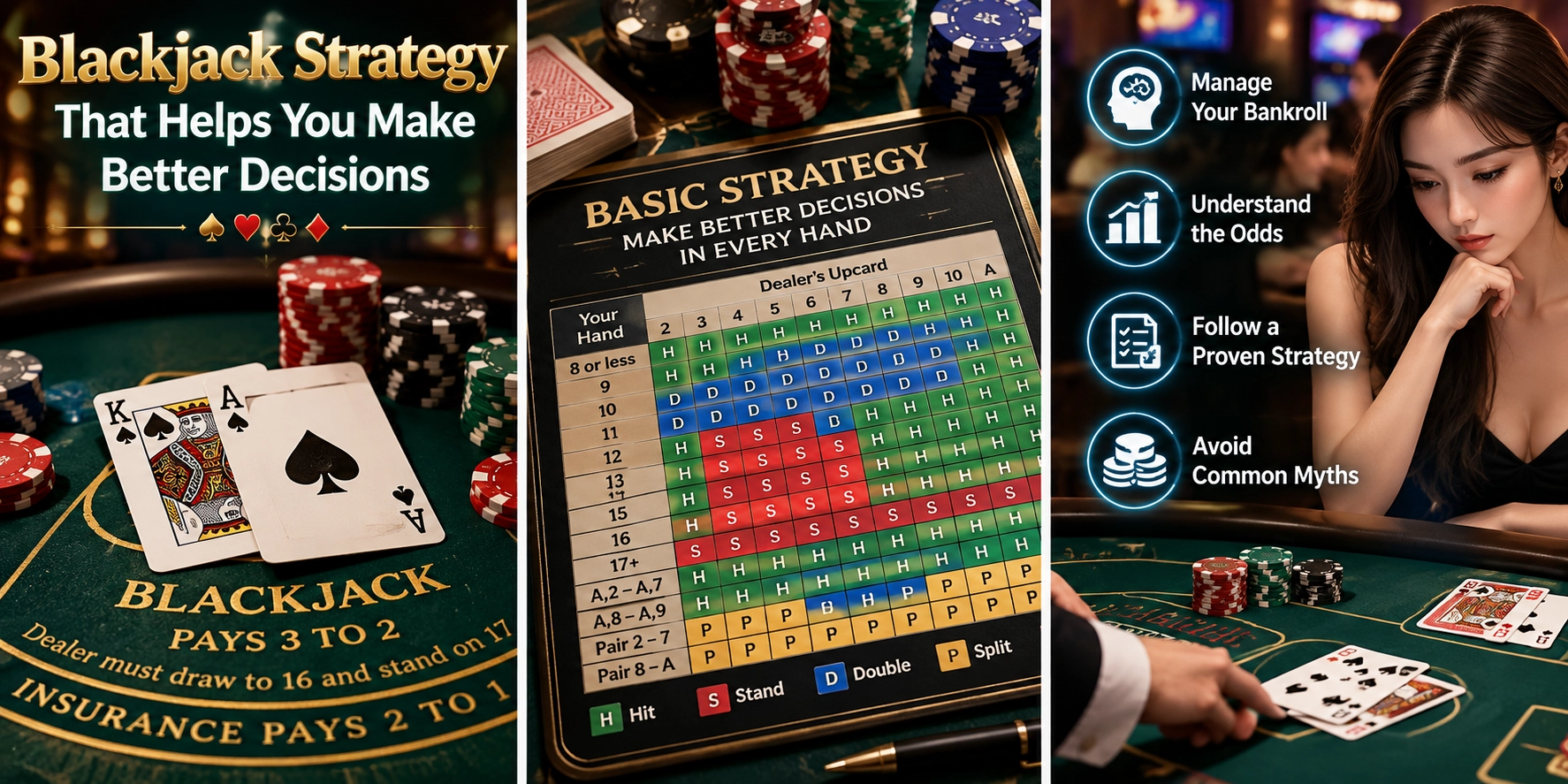
Blackjack Strategy That Helps You Make Better Decisions
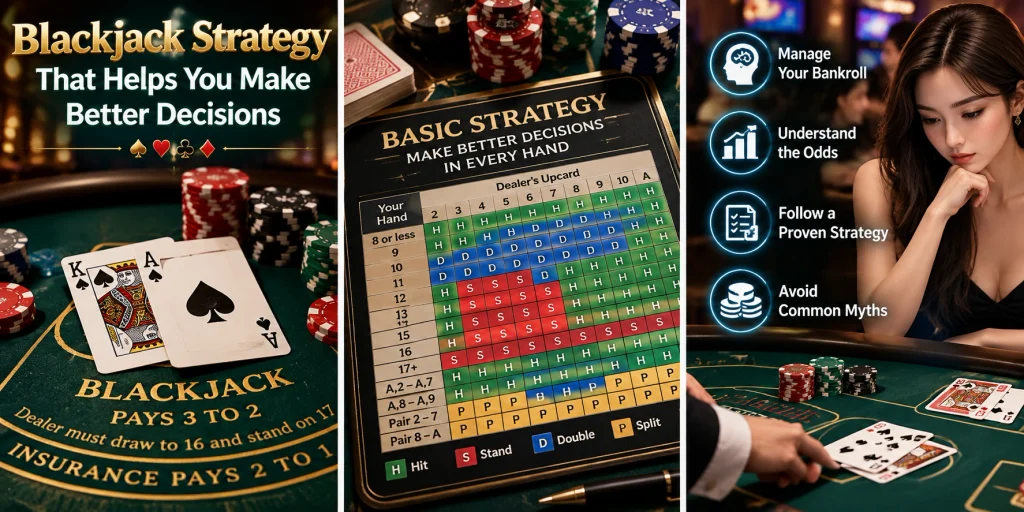
A good blackjack strategy isn’t about predicting the next card. It’s about making better decisions with the information you have, reducing common mistakes, and staying consistent throughout your session.
What Makes a Good Blackjack Strategy?
Many beginners search for a blackjack strategy hoping to find a system that guarantees wins.
That’s not how blackjack works.
The purpose of a strategy is much simpler: help you make stronger decisions whenever it’s your turn to act.
Every hand presents a choice.
Should you:
- Hit?
- Stand?
- Double Down?
- Split?
A good strategy helps you answer those questions based on the cards on the table instead of reacting to emotions or previous results.
For example, imagine two different situations:
| Your Hand | Dealer’s Upcard | Should You Think the Same Way? |
| 16 | 6 | No |
| 16 | 10 | No |
Although your total is 16 in both cases, the dealer is showing a different card. That changes how many players evaluate the hand.
This is why blackjack isn’t simply about remembering one rule for every total. Good decisions come from considering both your hand and the dealer’s visible card.
A Strategy Helps You Avoid Predictable Mistakes
The biggest benefit of following a strategy isn’t winning every hand.
It’s avoiding decisions that repeatedly put you at a disadvantage.
For example, beginners often:
- Stand because they’re afraid of busting.
- Split matching cards without thinking.
- Double Down after losing several hands.
- Change their approach because they feel “due” for a win.
None of these decisions are based on the cards currently on the table.
A better strategy keeps your attention on the present hand rather than on what happened a few minutes ago.
Over time, this creates more consistent decision-making—even though the outcome of any individual hand remains unpredictable.
Four Decisions Every Blackjack Player Should Master
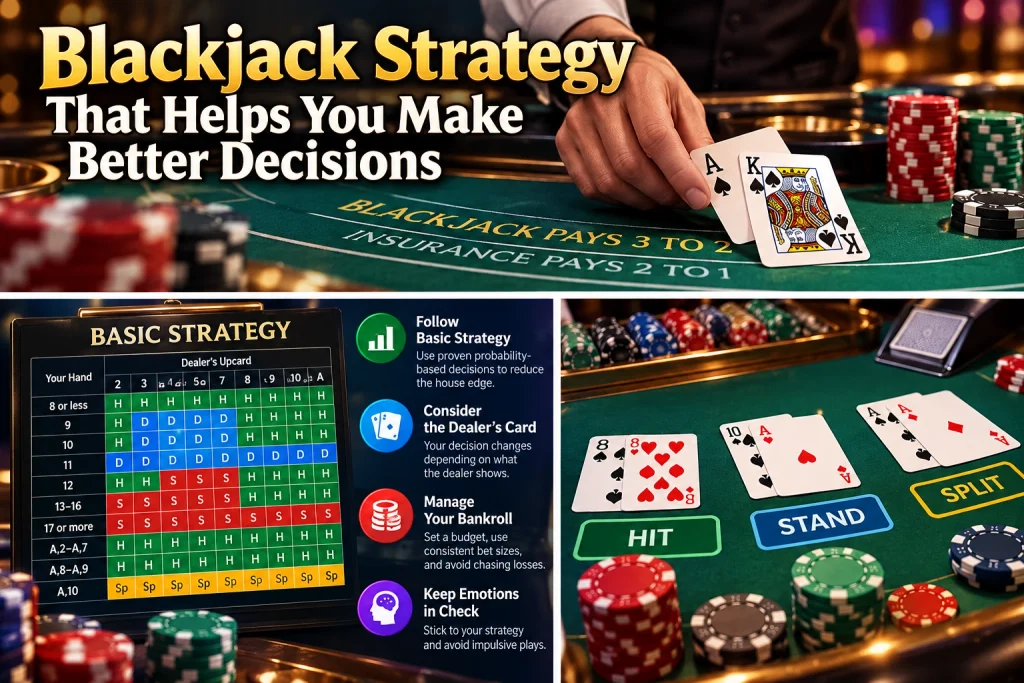
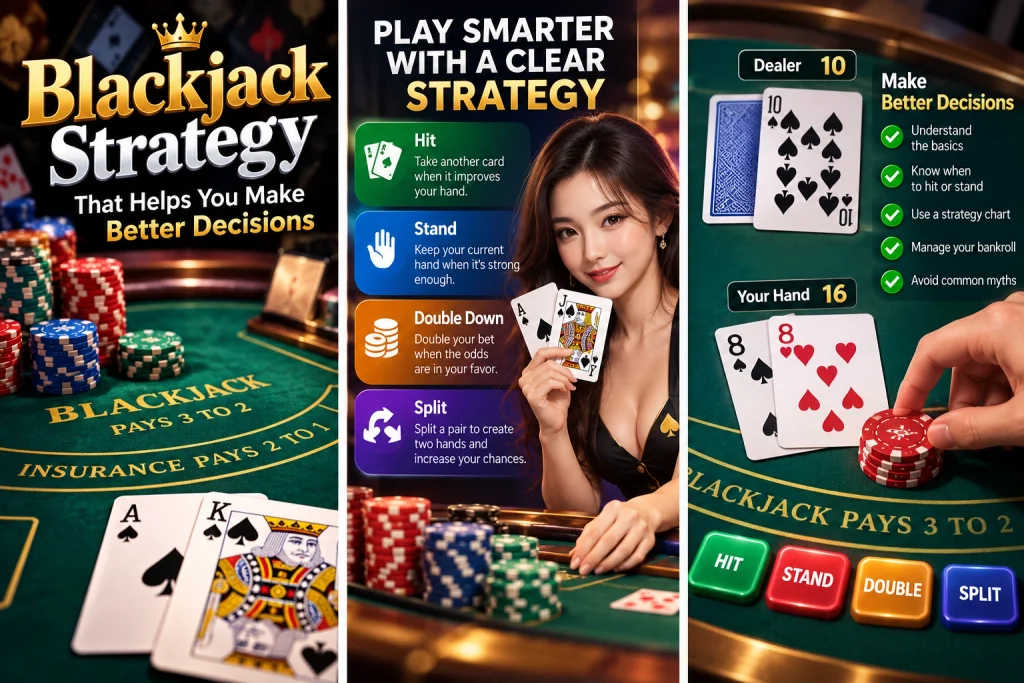
Every blackjack hand eventually comes down to one of four actions.
Learning when each action deserves consideration is far more useful than memorizing complicated charts.
Hit
Choosing Hit means taking one additional card.
This is commonly considered when your current hand isn’t strong enough to compete with the dealer.
For example:
| Your Hand | Dealer Shows | Common Thought |
| 8 | Any card | Improve the hand |
| 11 | 9 | One more card could create a strong total |
The purpose of hitting isn’t to chase the highest number possible. It’s to improve a hand that currently has limited winning potential.
Stand
Standing means you’re satisfied with your current total.
A stronger hand often has more to lose than to gain by taking another card.
Typical examples include:
| Your Hand | Dealer Shows | Common Thought |
| 17 | Any card | Already a solid total |
| 19 | 6 | Little reason to risk another card |
Standing isn’t about playing cautiously.
It’s about recognizing when your current hand is already in a good position.
Double Down
Double Down allows you to increase your original bet in exchange for receiving just one more card.
This option is generally considered when your current hand already has strong potential.
Example:
- Your hand: 11
- Dealer shows: 6
Many players view this as a stronger opportunity than average because many next cards can create a competitive total.
The key idea is simple:
Double Down should be part of your strategy—not a reaction to previous losses.
Split
Splitting turns one pair into two separate hands.
The important lesson for beginners is that not every matching pair should be split.
Compare these examples:
- 8 + 8
- 10 + 10
Although both are matching pairs, they don’t create the same situation.
Many strategy guides recommend treating these hands differently because their starting values are very different.
Rather than splitting automatically, first ask whether separating the pair actually improves your position.
How to Read the Dealer’s Upcard
One of the most valuable blackjack habits is looking at both hands before making a decision.
Many beginners focus only on their own cards, but the dealer’s upcard provides important context. The same total can lead to different decisions depending on what the dealer is showing.
You don’t need to calculate probabilities. Start by recognizing whether the dealer’s visible card appears relatively strong or weak, then compare it with your own hand.
When the Dealer Shows a Lower Card
Imagine these situations:
| Your Hand | Dealer’s Upcard |
| 15 | 4 |
| 16 | 5 |
| 17 | 6 |
In these examples, many players become more cautious about taking another card because their current total may already be competitive.
The key point isn’t that these hands guarantee a win. It’s that risking another card may not always improve an already reasonable position.
When the Dealer Shows a Higher Card
Now compare these hands:
| Your Hand | Dealer’s Upcard |
| 12 | 10 |
| 13 | Ace |
| 15 | 9 |
Although your hand may look similar to the previous examples, the dealer’s visible card changes the situation.
Instead of asking, “Is my hand good?”, ask:
“How does my hand compare with what the dealer is showing?”
This simple habit leads to more thoughtful decisions than relying only on your own total.
Every Decision Uses Two Hands
A useful rule to remember is:
Blackjack decisions are based on your hand and the dealer’s upcard—not your cards alone.
Before every action, take a moment to compare both hands. Over time, this becomes a natural part of your decision-making process and helps reduce avoidable mistakes.
Common Blackjack Strategy Mistakes
Even players who know the basic rules can make poor decisions if they react emotionally.
Most strategy mistakes happen because players ignore the current hand and focus on what happened earlier in the session.
Standing Too Early
A common beginner reaction is:
“I don’t want to bust.”
That concern is understandable, but standing isn’t always the safer decision.
Consider this hand:
- Your total: 12
- Dealer shows: 10
Some beginners immediately Stand because they’re worried about going over 21.
The problem is that 12 is already a difficult hand against a dealer showing 10. Standing simply because you’re afraid to bust may leave you with a hand that struggles to compete.
Good strategy comes from evaluating the situation—not from avoiding risk at all costs.
Splitting Every Pair
Matching cards often tempt beginners to split automatically.
For example:
- 5 + 5
- 10 + 10
Both hands contain matching cards, but that doesn’t automatically make splitting the strongest choice.
Instead of asking:
“Are the cards the same?”
Ask:
“Will splitting improve my position?”
Thinking this way helps you make decisions based on the value of the hand rather than the appearance of the cards.
Doubling Down at the Wrong Time
Some players treat Double Down as a way to recover after a losing streak.
A typical session might look like this:
- Lose two hands.
- Increase the next bet with Double Down because it feels like a good time to recover.
- Lose again and become even more frustrated.
Double Down should never be used because of previous results.
Its purpose is to strengthen a hand that already has favorable potential—not to chase losses.
Letting Previous Hands Affect the Next Decision
Blackjack hands are independent.
Winning three hands in a row doesn’t mean the fourth hand is more likely to lose.
Losing several hands doesn’t mean a win is “due.”
Before making each decision, focus only on:
- Your current cards.
- The dealer’s upcard.
- The available actions.
Leaving previous hands behind is one of the simplest ways to improve consistency during a blackjack session.
Can You Win Without Card Counting?
Yes—but it’s important to understand what “winning” means in blackjack.
Many people assume that successful blackjack players rely on card counting. While card counting is a well-known technique, it isn’t necessary for most casual players.
If your goal is to enjoy the game and make fewer mistakes, building a solid decision-making routine is usually much more valuable than learning advanced systems.
A practical blackjack strategy focuses on habits you can apply every hand:
- Compare your hand with the dealer’s upcard before acting.
- Know the purpose of Hit, Stand, Double Down, and Split.
- Avoid changing your decisions because of previous wins or losses.
- Keep your betting size consistent throughout the session.
These habits won’t tell you what the next card will be, but they can help you avoid many of the mistakes that beginners make repeatedly.
For most players, mastering these fundamentals is a better starting point than spending hours trying to learn card counting techniques.
Practicing Your Blackjack Strategy on PT Gaming
Once you understand the basic decision-making process, the next step is applying it consistently.
PT Gaming provides a straightforward way to start a blackjack session without complicated setup.
Download the Official App
Download the official PT Gaming app from:
Using the official download page helps ensure you’re installing the latest version of the app.
Sign In with Your Mobile Number
PT Gaming supports mobile number login.
For account security, an OTP verification code is required every time you sign in.
After logging in, you can also access useful account features, including:
- Transaction history
- VIP information
Start Your First Blackjack Session
Getting started only takes a few steps:
- Open the game lobby.
- Select the Blackjack category.
- Choose a table that matches your preferred betting level.
- Decide your bankroll before placing the first bet.
- Apply the same strategy throughout the session instead of changing decisions after every hand.
If you’re still learning blackjack, beginning with smaller wagers gives you more opportunities to practice decision-making without unnecessary pressure.
FAQ
What is the best blackjack strategy for beginners?
The best starting point is learning when to Hit, Stand, Double Down, or Split while paying attention to the dealer’s upcard. Building consistent decision-making habits is more useful than looking for a guaranteed winning system.
Should I always follow the same blackjack strategy?
A good blackjack strategy is consistent, but your decision should still depend on the current hand. The dealer’s upcard and your own cards together determine which action is worth considering.
Do I need to learn card counting?
No. Most casual players never use card counting. Understanding the four basic actions and avoiding common mistakes is enough to build a solid foundation.