Roulette Odds Explained: Understanding Risk Before You Bet
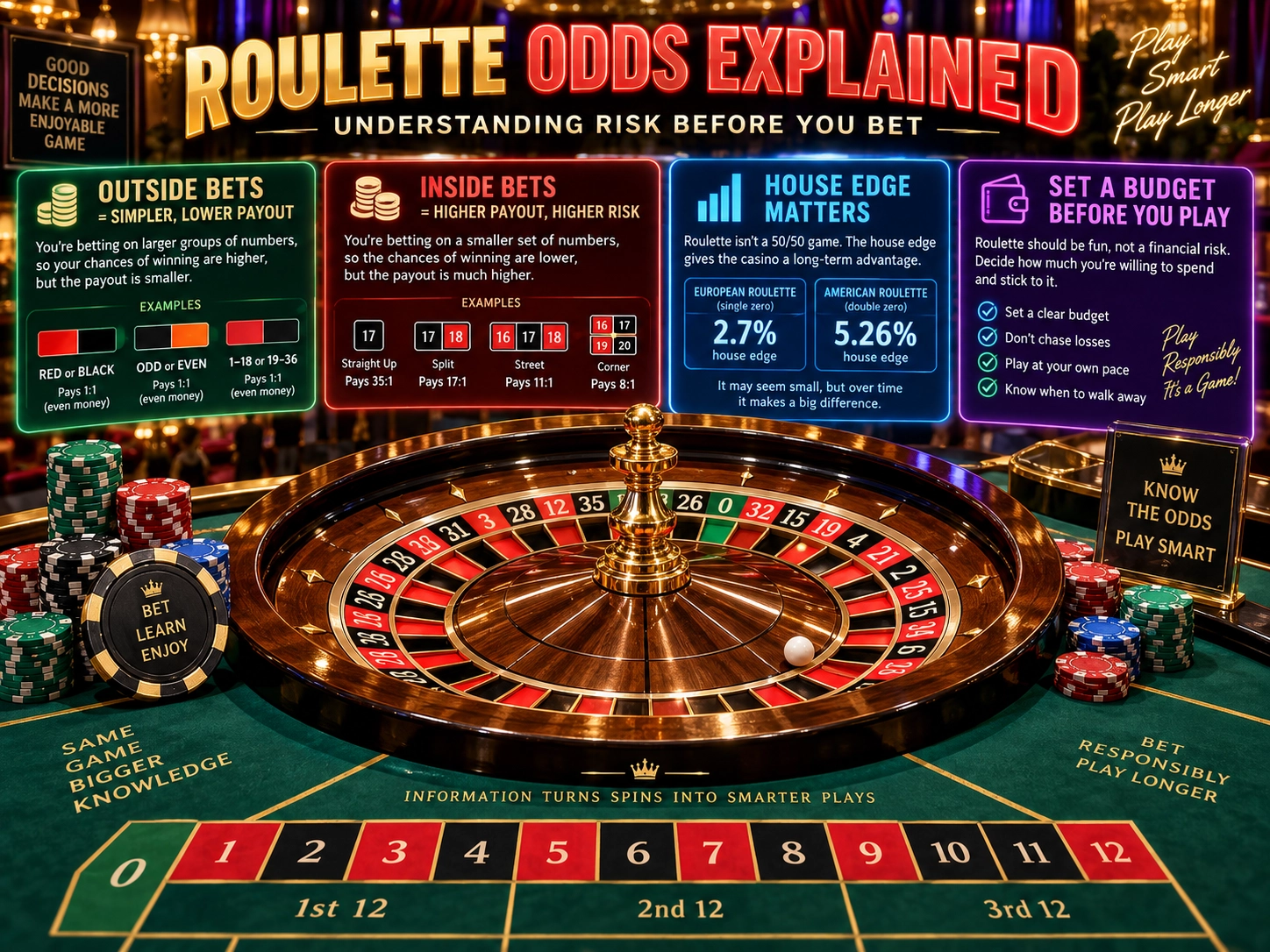
Understanding roulette odds explained doesn’t require learning complicated probability formulas. What matters is knowing how different bets affect your chances of winning and why a higher payout usually comes with higher risk.

What Do Roulette Odds Actually Mean?
The word odds appears in almost every roulette guide, but many beginners confuse it with payout.
They aren’t the same thing.
- Odds describe how likely a bet is to win.
- Payout describes how much the casino pays if that bet wins.
A bet with a large payout often has lower winning odds, while a bet with a smaller payout is generally easier to hit.
Here’s a simple comparison.
| Bet Example | Typical Payout | General Winning Frequency |
| Red or Black | Lower | Higher |
| Even or Odd | Lower | Higher |
| Single Number | Much Higher | Lower |
This doesn’t mean one option is always better than another.
It simply shows the trade-off between risk and reward.
Many first-time players see a payout like 35 to 1 on a single-number bet and assume it’s the smartest choice because the reward looks impressive.
In reality, the higher payout exists because that outcome is much less likely to occur than broader bets such as Red, Black, Even, or Odd.
A useful way to think about roulette is this:
The bigger the potential reward, the more difficult the bet usually is to hit.
Once you understand that relationship, the betting table becomes much easier to read.
Inside Bets vs Outside Bets: What’s the Difference?
Almost every roulette bet belongs to one of two categories:
- Inside Bets
- Outside Bets
The difference isn’t just where the chips are placed on the table. It also changes the balance between risk and potential reward.
Inside Bets
Inside bets are placed on the numbered section of the roulette layout.
Examples include:
- A single number
- Two adjacent numbers
- Three numbers
- Four numbers
These bets usually offer larger payouts because you’re covering fewer numbers with each wager.
For example, betting on a single number gives you the chance to win a much larger payout than betting on Red—but it’s also much less likely to hit.
Outside Bets
Outside bets cover larger groups of numbers.
Common examples include:
- Red or Black
- Even or Odd
- High (19–36)
- Low (1–18)
Since these bets cover many more numbers, they generally win more often than inside bets. The trade-off is that their payouts are much smaller.

Which Type Is Better for Beginners?
Neither category is “better.”
They simply serve different purposes.
The comparison below makes the difference easier to understand.
| Bet Type | Covers | Typical Payout | General Risk |
| Inside Bet | Few numbers | Higher | Higher |
| Outside Bet | Many numbers | Lower | Lower |
For someone playing roulette for the first time, outside bets are often easier to understand because the betting options are straightforward and the results appear more frequently.
That doesn’t make inside bets a bad choice. It simply means beginners should recognize that larger payouts come with a lower chance of winning.
Why Higher Payouts Usually Mean Lower Winning Chances
One of the biggest misunderstandings about roulette is believing that the highest-paying bets offer the best value.
They don’t.
A larger payout simply reflects that the outcome is harder to hit.
Consider these two betting choices.
Scenario 1: Betting on Red
You place a bet on Red before the wheel spins.
If the ball lands on any red pocket, your bet wins.
Because you’re covering a large group of numbers, this type of wager generally has a higher chance of winning than betting on a single number. The trade-off is a lower payout.
For many beginners, this makes Red or Black a comfortable way to learn how roulette works without focusing on dozens of betting options.
Scenario 2: Betting on One Number
Now imagine placing the same stake on 17.
If the ball lands anywhere else, the bet loses.
If it lands exactly on 17, the payout is much larger than a Red or Black bet.
The potential reward is attractive, but so is the risk. You are relying on a single outcome instead of a group of numbers.
This is why experienced players often look at both risk and reward before deciding where to place their chips, rather than choosing the bet with the highest payout.
A Simple Way to Compare Bet Types
Instead of memorizing every payout on the table, remember this general rule.
| Betting Style | Typical Reward | Typical Risk |
| Cover more numbers | Lower payout | Lower risk |
| Cover fewer numbers | Higher payout | Higher risk |
This won’t tell you which bet to choose, but it helps explain why different payouts exist.
Understanding this relationship makes the roulette table far less intimidating for first-time players.
European Roulette vs American Roulette
If you’ve compared roulette tables online, you’ve probably noticed that not all wheels look the same.
The biggest difference is the number of zero pockets.
European Roulette
European Roulette has:
- Numbers 1 to 36
- One green zero (0)
Because there is only one zero, many players find this version simpler to understand when learning the game.
It’s also the version most beginners encounter when reading roulette strategy guides.
American Roulette
American Roulette includes:
- Numbers 1 to 36
- A single zero (0)
- A double zero (00)
The additional 00 creates one more possible landing spot for the ball.
For beginners, the important point isn’t calculating probabilities. It’s simply recognizing that American Roulette has an extra pocket compared with the European version.

Which Version Should Beginners Choose?
If both versions are available, many first-time players start with European Roulette because the layout is slightly simpler and easier to recognize.
Whichever version you choose, the betting principles remain the same:
- Higher payouts usually involve covering fewer numbers.
- Lower-risk bets usually cover larger sections of the wheel.
- Every spin is independent of the one before it.
Learning these fundamentals is more valuable than trying to memorize every payout or searching for a “lucky” section of the wheel.
Common Roulette Mistakes Beginners Make
Most beginner mistakes have nothing to do with understanding the wheel. They come from making decisions based on emotion instead of having a simple plan.
Recognizing these habits early can help you enjoy the game without turning every spin into unnecessary risk.
Chasing the Highest Payout
Seeing a large payout can make a bet look more attractive than it really is.
A typical session might look like this:
- A player notices that a single-number bet offers a much larger payout than Red or Black.
- They decide to place most of their chips on one number, hoping for a big win.
- After several spins without success, they continue making the same bet because the potential reward still looks appealing.
The payout hasn’t changed—but neither has the level of risk.
A higher reward doesn’t mean the bet is more likely to win. It simply reflects that you’re covering fewer possible outcomes.
Changing Bets After Every Spin
Another common habit is changing betting patterns after each result.
For example:
- The ball lands on Black several times.
- The next bet switches to Red because it “feels overdue.”
- After Red appears once, the player changes back to Black again.
This approach is driven by recent results rather than a consistent betting plan.
Every roulette spin is independent. The wheel doesn’t remember where the ball landed previously, so changing your bet after every outcome doesn’t improve your chances.
Believing a Number Is “Due”
Many players have experienced this thought:
“Number 7 hasn’t appeared for a long time. It has to come up soon.”
It sounds logical, but roulette doesn’t work that way.
Each spin starts from scratch. A number that hasn’t appeared for twenty spins has the same chance of appearing on the next spin as any other number on the wheel.
Choosing favorite numbers can make the game more enjoyable, but it’s important not to mistake personal preference for a prediction.
Ignoring Bankroll Limits
Some beginners focus entirely on choosing the “right” bet while forgetting to decide how much they’re willing to spend.
A more practical approach is to set a bankroll before the session begins.
For example:
- Decide your total budget before placing the first bet.
- Choose a betting amount that allows multiple rounds instead of risking everything on a few spins.
- Finish the session once you reach your planned limit, whether you’re ahead or behind.
This doesn’t influence where the ball lands, but it helps you stay in control of your decisions throughout the session.
Can You Improve Your Roulette Decisions?
You can’t predict where the ball will land.
What you can improve is the quality of the decisions you make before each spin.
That means:
- Understanding how different bets affect risk and potential reward.
- Choosing bet sizes that match your budget.
- Sticking with a consistent approach instead of reacting to every result.
- Accepting that short-term outcomes are unpredictable.
Many beginners spend too much time searching for “winning systems” or “lucky numbers.”
In practice, a better habit is to understand how the table works and manage expectations from the start.
Roulette is a game of independent spins. The goal isn’t to predict the next result—it’s to make informed choices regardless of what happened previously.
Playing Roulette Online on PT Gaming
Once you understand how roulette odds work, you’re ready to experience the game for yourself.
Getting started on PT Gaming is straightforward.
Download the Official App
Download the official PT Gaming app from:
Using the official download page ensures you’re installing the latest version of the app.
Sign In Securely
PT Gaming uses mobile number login.
For account security, an OTP verification code is required every time you sign in.
After logging in, you can also access useful account features, including:
- Transaction history
- VIP information
Choose a Roulette Table
After logging in:
- Open the game lobby.
- Select the Roulette category.
- Choose a table that matches your preferred betting level.
- Decide your session budget before placing your first wager.
- Focus on understanding the game rather than chasing large payouts.
Starting with a clear plan makes it easier to apply the ideas you’ve learned throughout this guide.
FAQ
What do roulette odds mean?
Roulette odds describe how likely a particular bet is to win. They are different from payouts, which show how much you receive if your bet is successful.
Are higher payouts better in roulette?
Not necessarily. Higher payouts usually mean you’re betting on fewer possible outcomes, making those bets more difficult to win than broader betting options.
What’s the difference between inside and outside bets?
Inside bets cover individual numbers or small groups of numbers and usually offer higher payouts. Outside bets cover larger sections of the table, such as Red/Black or Even/Odd, and generally have lower payouts but more frequent wins.