

Understanding poker hand ranking is the fastest way to make better decisions at the table. Before learning betting strategies or reading opponents, you should know which hands are stronger and how to compare them correctly.

What Is Poker Hand Ranking?
Poker hand ranking is the standard order used to determine which five-card hand wins when players reach a showdown.
No matter which poker variation you’re learning, recognizing hand strength is one of the first skills you need. If you’re unsure whether a Flush beats a Straight or how Two Pair compares with Three of a Kind, every decision becomes more difficult.
Learning the rankings first gives you a solid foundation before moving on to betting strategies or game-specific rules.
Why Hand Rankings Matter
Every poker hand ends with one question:
Which player has the stronger five-card hand?
The answer always comes from the hand ranking, not from which player has the highest individual card.
For example:
- Player A holds a Pair of Queens.
- Player B holds an Ace-high hand.
Although Player B has an Ace, Player A wins because One Pair ranks above High Card.
This simple comparison explains why understanding rankings is more important than focusing on individual cards.
Learn the Ranking Before Memorizing Strategies
Many beginners spend time learning when to raise, call, or fold before they can quickly identify winning hands.
A more practical approach is:
- Learn the order of the hands.
- Practice recognizing them instantly.
- Then move on to betting decisions.
Once hand recognition becomes automatic, following a poker game feels much more natural.
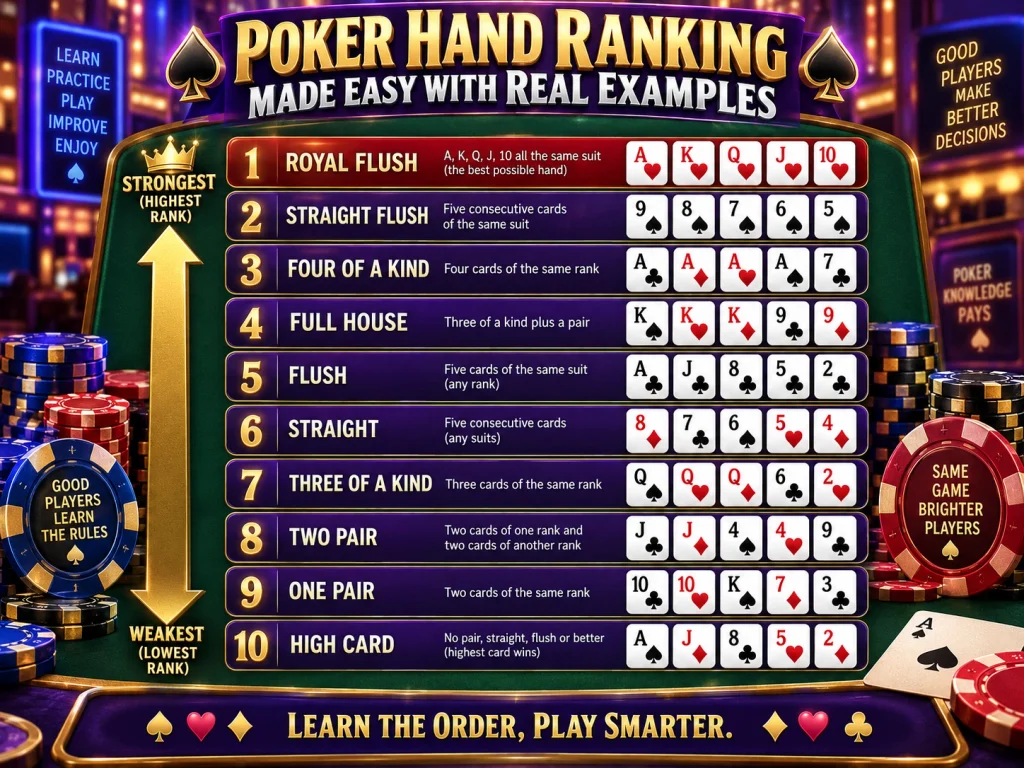
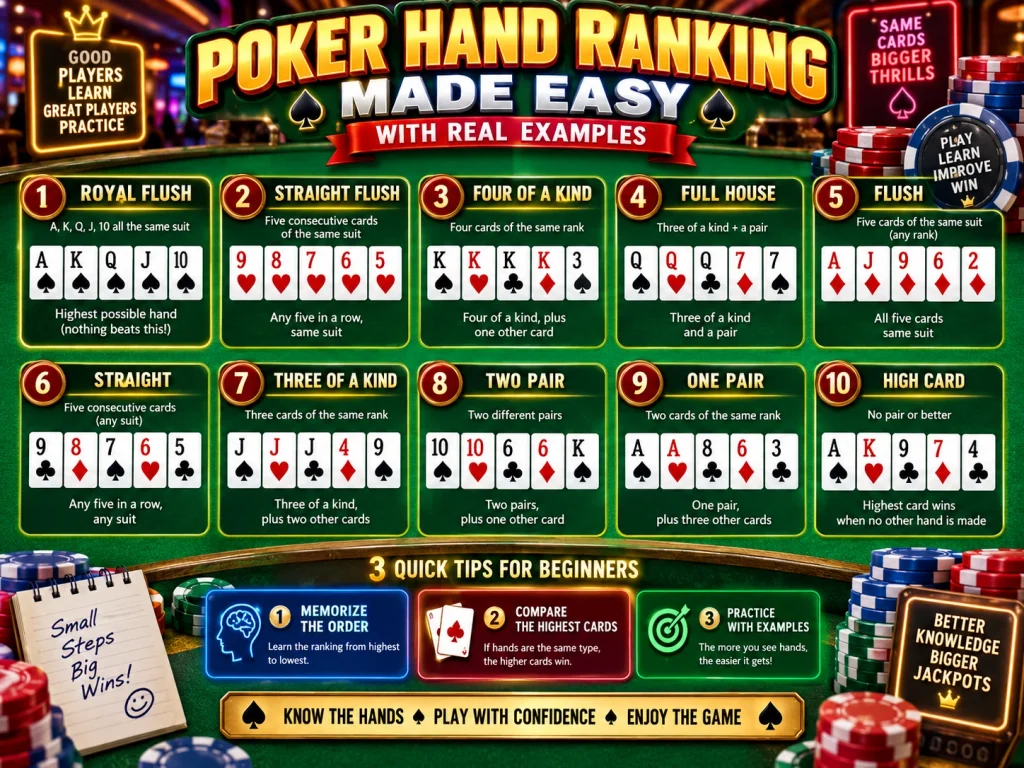
Poker Hand Rankings from Highest to Lowest
The easiest way to remember poker hand ranking is to study the complete list from strongest to weakest.
Rather than memorizing names alone, connect each ranking with a real example.
| Rank | Hand | Example |
| 1 | Royal Flush | A♠ K♠ Q♠ J♠ 10♠ |
| 2 | Straight Flush | 9♥ 8♥ 7♥ 6♥ 5♥ |
| 3 | Four of a Kind | K♣ K♦ K♥ K♠ 4♣ |
| 4 | Full House | Q♠ Q♦ Q♣ 8♥ 8♣ |
| 5 | Flush | A♣ J♣ 8♣ 6♣ 2♣ |
| 6 | Straight | 8♠ 7♦ 6♣ 5♥ 4♦ |
| 7 | Three of a Kind | 9♠ 9♦ 9♣ K♠ 3♥ |
| 8 | Two Pair | J♣ J♥ 5♦ 5♠ A♣ |
| 9 | One Pair | 10♠ 10♦ Q♣ 7♥ 3♠ |
| 10 | High Card | A♠ J♦ 8♣ 5♥ 2♦ |
Instead of trying to memorize the entire list in one sitting, focus on recognizing each hand when you see it. Repeated exposure to real card examples is usually more effective than memorizing names alone.
The Strongest Hands
The top four hands are easy to recognize because they contain very specific card patterns.
| Hand | How to Identify It |
| Royal Flush | A, K, Q, J, 10 of the same suit |
| Straight Flush | Five consecutive cards of the same suit |
| Four of a Kind | Four cards with the same rank |
| Full House | Three of one rank plus a separate pair |
These hands appear much less frequently than One Pair or Two Pair, but it’s important to recognize them immediately when they do.
The Most Common Hands You’ll See
During a typical poker session, you’ll usually encounter these hands more often:
- One Pair
- Two Pair
- Three of a Kind
- High Card
For example:
A♠ A♦ 9♣ 6♥ 3♦
This is One Pair, because two Aces form the highest matching rank.
Another example:
K♠ K♥ 7♦ 7♣ 4♠
This is Two Pair, since there are two Kings and two Sevens.
Learning to identify these common hands quickly is often more useful for beginners than spending time memorizing the rarest hands.
How to Compare Two Poker Hands
Recognizing each hand is only the first step.
The next skill is knowing why one hand beats another. Most comparisons follow a simple order: compare the hand type first, then compare the cards within that hand if necessary.
When the Hand Types Are Different
If the two players have different hand types, the higher-ranked hand always wins.
For example:
Player A
Q♠ Q♦ Q♣ 8♥ 8♣
Full House
Player B
A♣ J♣ 8♣ 6♣ 2♣
Flush
Although Player B has an Ace, Player A wins because a Full House ranks above a Flush.
When the hand categories are different, you don’t compare individual cards—you compare the hand rankings.
When Both Players Have the Same Hand Type
If both players have the same category of hand, you compare the strength within that category.
For example:
Player A
K♠ K♦ 9♣ 6♥ 2♠
One Pair (Kings)
Player B
Q♠ Q♦ A♣ J♥ 8♠
One Pair (Queens)
Both players have One Pair, but a Pair of Kings ranks higher than a Pair of Queens, so Player A wins.
The comparison always starts with the matched cards before looking at any remaining cards.
Understanding the Kicker
Sometimes both players have exactly the same pair.
That’s when the kicker becomes important.
Example:
Player A
A♠ A♦ K♣ 8♥ 3♠
Player B
A♣ A♥ Q♦ J♣ 7♦
Both players hold One Pair of Aces.
The pairs are identical, so the next highest unmatched card decides the winner.
Player A has a King as the highest remaining card, while Player B has a Queen.
Because King ranks above Queen, Player A wins.
This is one of the most common situations beginners misunderstand. They see the same pair and assume the pot is split, even though the kicker determines the stronger hand.
Poker Hand Ranking Mistakes Beginners Often Make
Most ranking mistakes happen because players focus on one card instead of the complete five-card hand.
Learning these common errors can help you avoid incorrect decisions during a game.
Thinking a Flush Beats a Full House
This is one of the most frequent ranking mistakes.
Example:
Player A
9♣ 9♦ 9♥ K♠ K♦
Full House
Player B
A♠ J♠ 9♠ 6♠ 3♠
Flush
The Flush may look impressive because all five cards share the same suit.
However, the Full House is the higher-ranked hand, so Player A wins.
Remembering the overall ranking order is more reliable than judging a hand by how unusual it looks.
Forgetting About the Kicker
Players often stop comparing hands once they see the same pair.
Consider this example:
Player A
J♠ J♦ A♣ 9♥ 4♠
Player B
J♣ J♥ K♦ 10♠ 8♣
Both players have a Pair of Jacks.
The pair is equal, so you compare the highest remaining card.
Player A has an Ace, while Player B has a King, which means Player A wins.
Ignoring the kicker can easily lead to the wrong conclusion.
Comparing Individual Cards Instead of Hand Rankings
Another common mistake is paying too much attention to the highest single card.
Example:
Player A
10♠ 10♦ 7♣ 5♥ 2♠
One Pair
Player B
A♠ K♦ 9♣ 6♥ 3♦
High Card
Even though Player B has an Ace and a King, Player A still wins because One Pair ranks above High Card.
Always identify the hand first before comparing individual cards.
Misreading a Straight
A Straight requires five consecutive ranks, regardless of suit.
Example of a Straight:
5♠ 6♦ 7♣ 8♥ 9♦
Not a Straight:
5♠ 6♦ 7♣ 9♥ 10♦
The second example contains high cards, but it skips the 8, so it isn’t consecutive.
Checking every rank in order helps prevent this mistake.
Practicing Poker Hand Rankings on PT Gaming
Reading examples on a page is a good way to learn the rankings, but recognizing hands during an actual game is a different skill.
The more real hands you see, the faster you’ll identify patterns without stopping to think through the entire ranking list.
Download the Official App
To start practicing, download the official PT Gaming app from:
Using the official download page helps ensure you’re installing the latest version available.
Sign In and Open a Poker Table
PT Gaming supports mobile number login.
For account security, an OTP verification code is required every time you sign in.
After logging in, you can also access useful account features, including:
- Transaction history
- VIP information
Once you’re in the game lobby, choose a poker table and begin observing how different hands are revealed at showdown.
A Simple Practice Routine
Instead of trying to memorize every hand ranking before playing, use each completed hand as a learning opportunity.
After the cards are revealed, ask yourself four questions:
- What is the highest-ranking hand on the table?
- Which five cards make that hand?
- If two players have the same hand type, what decides the winner?
- Could the result have been different if one card changed?
For example:
- A player holding A♠ A♦ K♣ 8♥ 3♠ has One Pair.
- Another player holding K♠ K♦ Q♣ 10♥ 4♣ also has One Pair.
Before looking at the result, decide which hand you think wins and explain your reasoning.
Repeating this exercise over multiple hands helps you recognize rankings naturally instead of relying on memorization.
FAQ
What is the highest poker hand?
The highest possible poker hand is a Royal Flush, which consists of A, K, Q, J, and 10 of the same suit. It ranks above every other hand in standard poker hand rankings.
Does a Flush beat a Full House?
No. A Full House ranks higher than a Flush. This is one of the most common mistakes made by new poker players.
What happens if two players have the same pair?
If both players have the same pair, the remaining cards—known as kickers—are compared. The player with the highest kicker wins if the pairs are identical.