Poker Hand Ranking Every Beginner Should Memorize
Learning poker hand ranking should be your first priority as a new player. If you can quickly recognize which hand is stronger, you’ll spend less time second-guessing your decisions and more time following the action at the table.
Why Memorizing Poker Hand Rankings Matters
Many beginners focus on betting rules before they can confidently identify winning hands.
A more effective approach is to memorize the ranking order first.
During a poker game, you won’t have time to stop and check a hand chart every time five cards are revealed. Recognizing the strength of a hand immediately makes it much easier to understand who is ahead and why.
Think of hand rankings as the foundation for everything else you learn in poker.
Faster Decisions at the Table
Imagine reaching a showdown and seeing these two hands:
Player A
K♣ K♦ K♥ 7♠ 7♦
Full House
Player B
A♠ Q♠ 10♠ 8♠ 5♠
Flush
If you’ve already memorized the ranking order, you know immediately that the Full House wins.
Without that knowledge, you’ll spend time comparing individual cards instead of comparing the hand categories.
The quicker you recognize the hand type, the quicker you can understand the result.
It Helps You Avoid Common Beginner Mistakes
Many ranking errors happen because players remember only part of the order.
For example, some beginners assume:
- An Ace always wins.
- A Flush beats a Full House.
- Two Pair is stronger than Three of a Kind.
These mistakes disappear once the ranking order becomes familiar.
Instead of guessing, you’ll already know where each hand belongs.
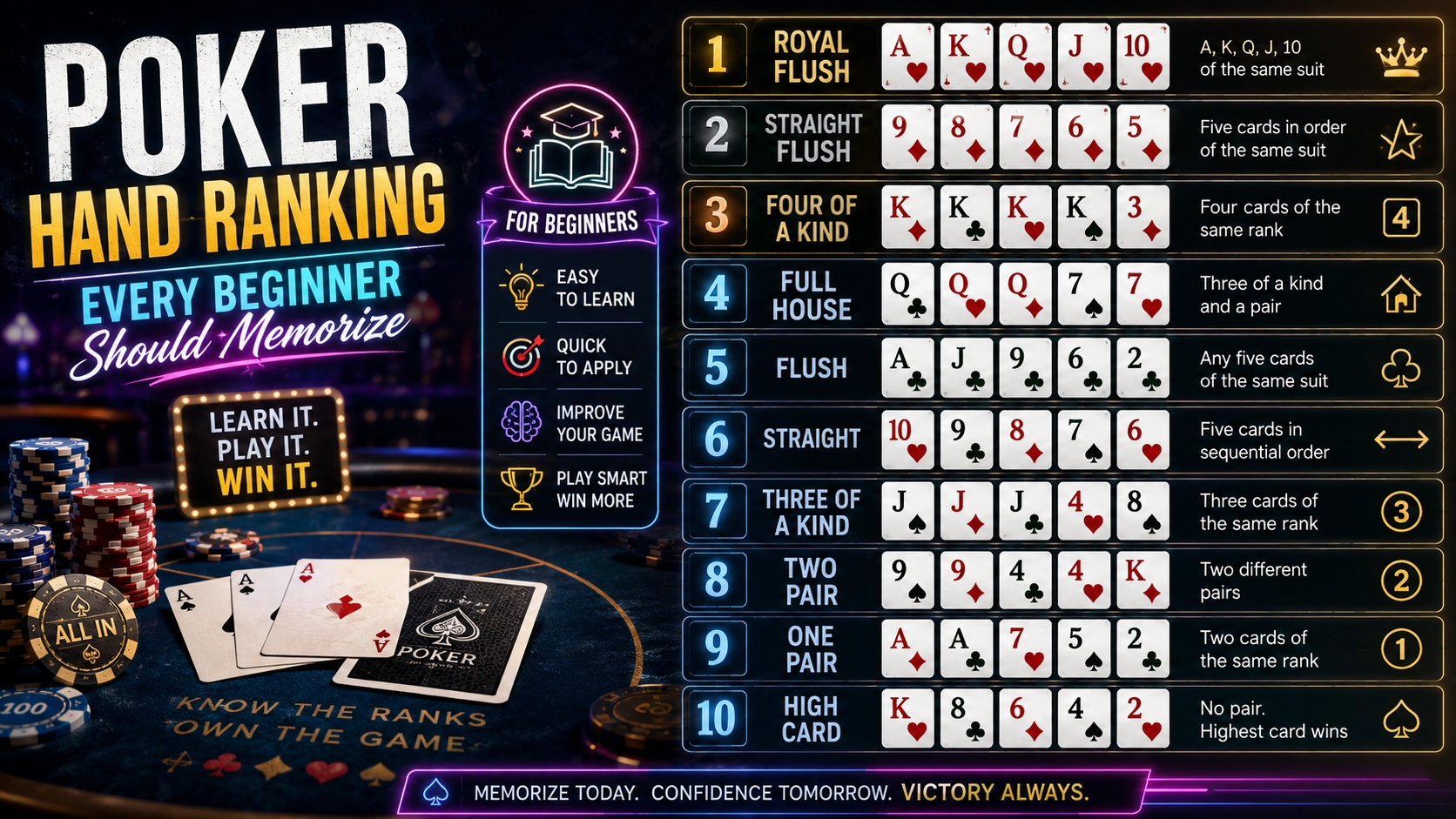
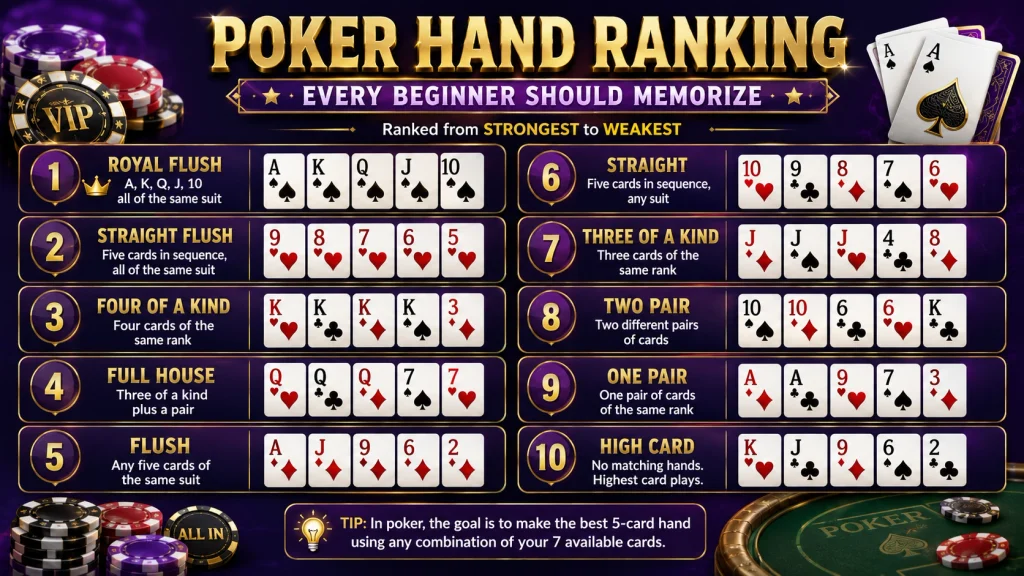
The Poker Hand Ranking Every Beginner Should Know
The easiest way to remember poker hand rankings is to learn them from the strongest hand to the weakest.
Rather than memorizing names alone, connect each hand with a simple visual pattern.
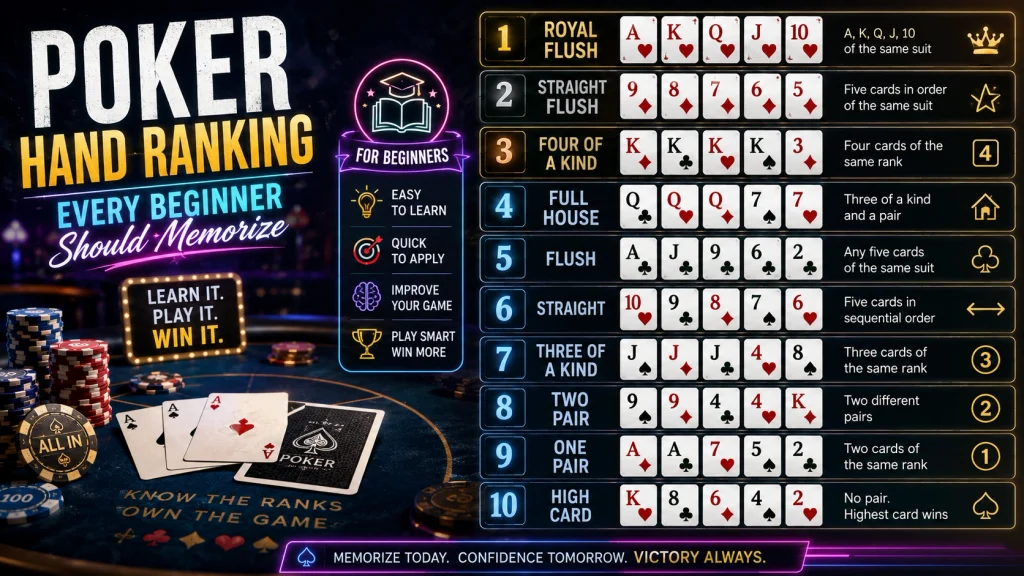
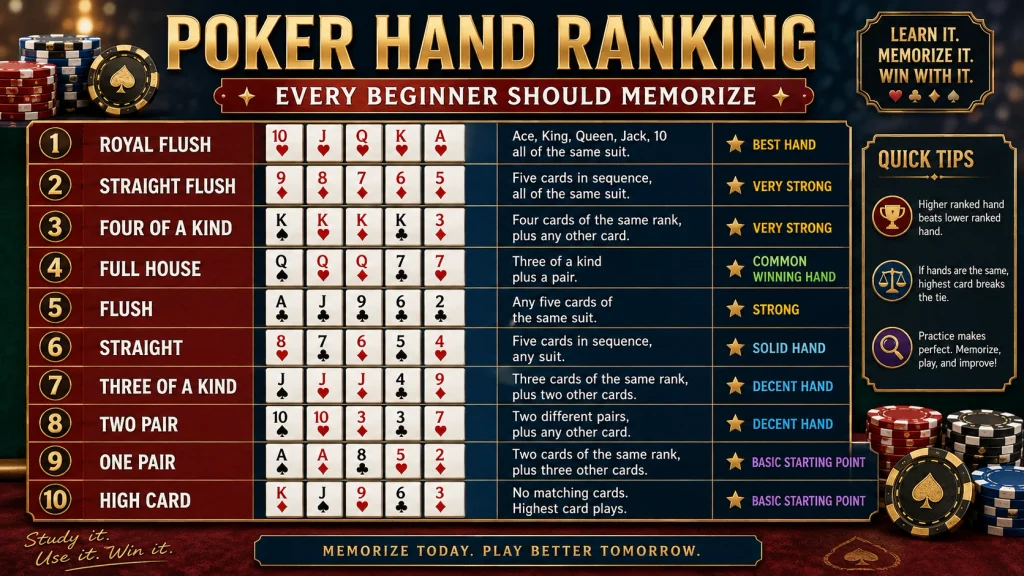
| Rank | Hand | Easy Memory Tip |
| 1 | Royal Flush | Highest possible straight in one suit |
| 2 | Straight Flush | Five consecutive cards of the same suit |
| 3 | Four of a Kind | Four cards with the same rank |
| 4 | Full House | Three matching cards plus one pair |
| 5 | Flush | Five cards of the same suit |
| 6 | Straight | Five consecutive ranks |
| 7 | Three of a Kind | Three cards of the same rank |
| 8 | Two Pair | Two separate pairs |
| 9 | One Pair | One matching pair |
| 10 | High Card | No other hand is formed |
Try reading the list from top to bottom several times instead of jumping between different hands. The order becomes easier to remember when you always study it in the same sequence.
Think in Groups Instead of Ten Separate Hands
Instead of treating every hand as completely different, group similar hands together.
| Group | Hands |
| Five-card patterns | Royal Flush, Straight Flush, Flush, Straight |
| Matching cards | Four of a Kind, Full House, Three of a Kind, Two Pair, One Pair |
| No combination | High Card |
This approach reduces the amount of information you need to remember at one time.
For example, once you recognize that Four of a Kind, Three of a Kind, and One Pair all depend on matching ranks, it’s easier to understand how they relate to one another.
Focus on Recognition Before Speed
Don’t worry about naming every hand instantly on your first day.
Instead, look at a hand and ask yourself:
- Are there matching cards?
- Are all the cards the same suit?
- Do the cards form a sequence?
- Which ranking does that create?
Following the same checklist each time helps build long-term memory naturally, and speed comes with practice.
Easy Ways to Remember the Ranking Order
Trying to memorize ten hand names at once can feel overwhelming.
A better approach is to remember why each hand is strong instead of repeating the list over and over. Once you recognize the patterns, recalling the ranking becomes much easier.
Learn from the Top Down
Many beginners remember the list more quickly by starting with the strongest hand and working downward.
The top of the ranking contains the most specific combinations, while the bottom contains the most common ones.
A simple learning order looks like this:
- Royal Flush
- Straight Flush
- Four of a Kind
- Full House
- Flush
- Straight
- Three of a Kind
- Two Pair
- One Pair
- High Card
Reading the list in the same order every time helps build consistent recall instead of forcing yourself to remember random positions.
Group Similar Hands Together
Another useful technique is to connect hands with similar characteristics.
For example:
Hands based on matching cards
- Four of a Kind
- Full House
- Three of a Kind
- Two Pair
- One Pair
Hands based on card patterns
- Royal Flush
- Straight Flush
- Flush
- Straight
Instead of learning ten unrelated names, you’re learning two main ideas:
- Matching ranks
- Card sequences and suits
This makes the ranking feel much more logical.
Remember the “More Specific = Higher” Rule
When two hands seem similar, ask yourself:
Which hand requires a more specific combination of cards?
For example:
- A Flush only requires five cards of the same suit.
- A Straight Flush requires both five consecutive cards and the same suit.
Because the Straight Flush has more conditions, it ranks higher.
The same idea helps explain why:
- Four of a Kind ranks above Three of a Kind.
- Full House ranks above One Pair.
- Two Pair ranks above One Pair.
Thinking about the number of conditions is often easier than trying to memorize every comparison individually.
Which Poker Hands Appear Most Often?
Not every poker hand appears with the same frequency during play.
When you’re first learning poker, it’s more useful to become familiar with the hands you’ll see regularly instead of focusing only on rare combinations.
One Pair
One Pair is one of the first hands most beginners learn to recognize.
Example:
Q♠ Q♦ 9♣ 6♥ 2♠
The two Queens immediately identify the hand.
Because you’ll encounter One Pair frequently, recognizing it quickly helps build confidence during real games.
Two Pair
Two Pair is another common hand.
Example:
K♠ K♦ 5♣ 5♥ A♣
Notice that two different ranks are paired.
A simple habit is to scan the cards from left to right and ask:
- Is there one pair?
- Is there a second pair?
If the answer is yes, you’ve identified Two Pair.
Three of a Kind
Three matching cards are easy to spot once you begin looking for repeated ranks.
Example:
8♠ 8♦ 8♣ J♥ 4♦
Rather than counting every card, focus first on whether one rank appears three times.
If it does, you’ve already narrowed the possible hand significantly.
High Card
High Card often surprises beginners because it isn’t really a combination.
Example:
A♠ J♦ 9♣ 6♥ 3♠
There are:
- No matching ranks.
- No five-card sequence.
- No five cards of the same suit.
When none of the higher-ranking hands are formed, the hand is simply evaluated by its highest card.
Learning to recognize High Card is just as important as recognizing stronger hands because it completes your understanding of the entire ranking system.
Practice the Hands You’ll See Most
A practical study routine is to master the most common hands before worrying about the rarest ones.
For example:
| Learn First | Learn Next |
| High Card | Straight |
| One Pair | Flush |
| Two Pair | Full House |
| Three of a Kind | Four of a Kind, Straight Flush, Royal Flush |
This approach reflects what you’ll typically encounter during play and helps you build confidence one step at a time.
Common Memory Mistakes Beginners Make
Most beginners don’t struggle because poker hand rankings are complicated. They struggle because a few hands look similar or because they focus on one card instead of the complete five-card combination.
Recognizing these common mistakes can make the ranking order much easier to remember.
Mixing Up a Flush and a Straight
A Flush and a Straight are often confused because both use five cards.
The difference is simple:
- A Flush is based on five cards of the same suit.
- A Straight is based on five consecutive ranks.
Compare these examples:
Flush
A♣ J♣ 8♣ 6♣ 2♣
Straight
5♠ 6♦ 7♣ 8♥ 9♦
One depends on matching suits, while the other depends on consecutive values.
Looking for suits first and sequence second is an easy way to separate the two.
Forgetting Where a Full House Fits
Another common mistake is remembering the cards that form a Full House but forgetting where it sits in the ranking.
A simple way to remember it is:
A Full House combines two made hands—a Three of a Kind and a Pair.
Because it requires both patterns at the same time, it ranks above a Flush but below Four of a Kind.
Instead of memorizing its exact position every time, remember what it’s made of.
Thinking an Ace Always Wins
Many new players assume that an Ace automatically creates the strongest hand.
Consider these two hands:
Player A
A♠ K♦ 9♣ 6♥ 2♦
High Card
Player B
10♠ 10♦ Q♣ 7♥ 3♠
One Pair
Even though Player A holds an Ace, Player B wins because One Pair ranks above High Card.
The lesson is simple:
Identify the hand first. Compare individual cards second.
Confusing Two Pair with Three of a Kind
At a quick glance, these hands can appear similar because both contain matching cards.
Compare them carefully:
Two Pair
K♠ K♦ 8♣ 8♥ 4♠
Three of a Kind
9♠ 9♦ 9♣ J♥ 2♦
A useful shortcut is to count how many cards share the same rank before looking at anything else.
If one rank appears three times, it’s Three of a Kind.
If two different ranks appear twice, it’s Two Pair.
Practice Poker Hand Rankings on PT Gaming
The fastest way to remember poker hand rankings is to apply them during real games.
Instead of trying to memorize the list in one sitting, use every showdown as an opportunity to test yourself.
Download the Official App
Download the official PT Gaming app from:
Using the official download page helps ensure you’re using the latest version of the app.
Sign In and Start Observing Hands
PT Gaming supports mobile number login.
For account security, an OTP verification code is required every time you sign in.
After logging in, you can also access:
- Transaction history
- VIP information
When watching a poker game, pause for a moment before the winner is shown and try to identify the strongest hand yourself.
This simple habit reinforces the ranking order much more effectively than repeatedly reading a chart.
Build a Daily Recognition Habit
You don’t need a long study session to improve.
A few minutes of focused practice can be enough.
For each hand that reaches a showdown, ask yourself:
- What is the hand type?
- Where does it rank?
- What feature helped me identify it?
- Did I recognize it correctly before seeing the result?
Over time, you’ll spend less time thinking about the ranking and more time recognizing each hand automatically.
FAQ
What’s the easiest way to memorize poker hand rankings?
Start from the strongest hand and work down to the weakest. Studying the rankings in the same order every time and grouping similar hands together makes them easier to remember than trying to memorize random combinations.
Should beginners memorize every poker hand?
Yes. You don’t need to master advanced strategy immediately, but you should be able to recognize all ten standard poker hand rankings before playing regularly.
Which poker hands should I learn first?
Most beginners benefit from recognizing the hands they’ll see most often, including High Card, One Pair, Two Pair, and Three of a Kind. Once these become familiar, it’s easier to remember the less common hands.